

The Demographic Challenge: 85% Enrollment Jump Required
NEW DELHI – India’s higher education system is facing a profound structural challenge, needing an 85% surge in enrollments over the next decade to meet the ambitious targets set by the National Education Policy (NEP) 2020. A new report by the Confederation of Indian Industry (CII) and Grant Thornton Bharat has projected that the country must accommodate 86.11 million students by 2035 to achieve a Gross Enrollment Ratio (GER) of 50%.
This target, which requires a sustained 5.3% Compound Annual Growth Rate (CAGR) in higher education capacity, is described by the report as an “operational imperative” rather than merely a policy aspiration. The massive scale required highlights the sector’s most urgent crisis: its ability to transform its delivery model rapidly enough to capitalize on the nation’s vaunted demographic dividend.
Traditional Campuses Are Insufficient
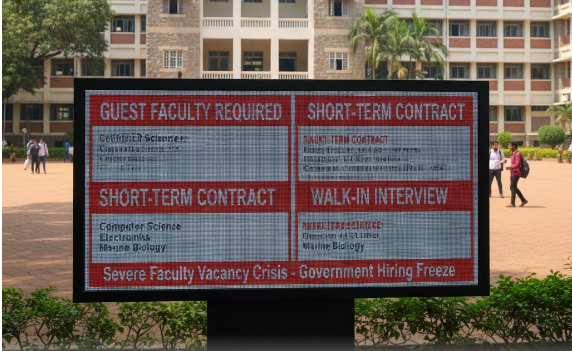
The report, titled “Continuous Improvement Journey of Higher Education Institutions: Approaches and Practices Shaping the Future of Learning,” warns explicitly that the existing system of traditional brick-and-mortar institutions, while foundational, is structurally incapable of absorbing the impending swell of learners. With many physical campuses already grappling with faculty shortages (exceeding 30% in some state universities) and infrastructure strains, a radical shift is unavoidable.
“Traditional brick-and-mortar institutions will remain foundational, but they alone cannot meet this scale,” the report states.
This conclusion necessitates a “differentiated approach” involving systemic innovation. Policy analysts and educational leaders are now pressing for the immediate and large-scale adoption of technology-enabled, flexible learning pathways. This includes the proliferation of digital universities, virtual learning ecosystems, and credit-based online programmes that can expand access without proportionate physical infrastructure demands.
Employability Becomes a Core Design Principle
The drive for scale is paralleled by an urgent need for quality and relevance. The report emphasizes that higher education can no longer treat employability as a simple byproduct of a degree. With nearly 40% of core job skills expected to evolve by 2030, institutions must embed employability as a deliberate design principle.
This requires a fundamental redesign of curricula to incorporate:
- Micro-credentials and modular credits for flexible skill acquisition.
- Work-integrated learning (W-I-L) and mandatory internships.
- The use of AI-enabled assessments and deep industry partnerships to align academic outcomes with market needs.
In essence, the dialogue in India’s higher education is rapidly shifting from one of access only to one that critically includes scale and quality. The next decade will define whether India’s youth population acts as a powerful engine for economic transformation or the epicenter of unmet potential.