
Ithaca (New York) | November 8, 2025
Cornell University has reached a landmark settlement with the U.S. federal government to restore more than US $250 million in frozen research funding, ending months of uncertainty that had disrupted key academic and scientific projects. Under the agreement, Cornell will pay a $30 million settlement, invest heavily in new research initiatives, and adapt staff training and administrative practices to reflect revised civil-rights interpretations by the current administration.
The deal, finalised after weeks of negotiations, follows an extensive federal review of Cornell’s diversity, equity and inclusion (DEI) policies and handling of campus antisemitism complaints. The inquiry had led to a freeze on dozens of federally funded research projects, including those supported by the Department of Defense, National Institutes of Health, and Department of Agriculture, resulting in halted experiments, suspended grants, and delayed student stipends.
Key Terms of the Settlement
According to The Guardian and other U.S. media outlets, the settlement outlines a multi-part compliance and restoration plan:
- Cornell will pay $30 million directly to the federal government.
- It will invest another $30 million in agricultural and applied research, with a focus on artificial intelligence and robotics in farming, energy efficiency, and public-health technology.
- The university will provide admissions and demographic data through 2028, giving federal authorities access to anonymised records that track how race, geography, and socioeconomic status influence admissions outcomes.
- Cornell will revise staff and faculty training modules in line with the government’s new interpretation of Title VI of the Civil Rights Act, which restricts programs or practices that could be perceived as “race-based.”
- The university will continue to monitor and address campus-climate issues, particularly those involving Jewish students, through independent audits and annual reporting.
- In exchange, the federal government will lift all funding suspensions, allowing previously halted research contracts—estimated at US $250 million—to resume immediately.
University officials confirmed that the deal does not grant federal control over academic content, admissions decisions, or hiring processes. “Cornell retains full autonomy over its curriculum, governance, and policies,” a university statement said, stressing that the settlement preserves its core academic freedoms while addressing compliance concerns.
Background: How the Conflict Began
The dispute began earlier this year when the Trump administration accused several universities, including Cornell, of failing to address antisemitism on campus and of maintaining DEI programs that the government considered inconsistent with federal civil-rights law. In April 2025, the Department of Defense and other agencies issued “stop-work” orders for projects linked to Cornell’s research divisions, freezing tens of millions in active grants.
The freeze sent shockwaves through the academic community. More than 1,500 researchers and graduate students were affected, and multiple interdisciplinary projects—ranging from food security and bioengineering to cybersecurity—were placed on hold.
President Michael I. Kotlikoff described the freeze as a “severe disruption” that threatened faculty livelihoods and jeopardised Cornell’s contribution to national research priorities. “The suspension of federal funding upended lives and careers,” Kotlikoff said in a university statement, adding that the settlement restores Cornell’s ability to “pursue inquiry without fear of institutional paralysis.”
Reaction and Implications
While university officials welcomed the restoration of funds, the settlement has drawn mixed reactions from academics and policy experts.
Supporters argue that the agreement offers a path forward, balancing compliance with civil-rights requirements and the need to safeguard essential research. Federal officials praised Cornell’s cooperation, framing the deal as part of a broader campaign to ensure that taxpayer-funded research aligns with merit-based and non-discriminatory standards.
“This agreement restores trust and ensures that federal research funds are used in institutions committed to fairness and accountability,” said a senior Department of Education official.
However, critics—including faculty associations and civil-liberties groups—warn that the settlement may set a precedent for political interference in university governance. By requiring data disclosure and DEI realignment, they argue, the government could effectively reshape academic policy through funding leverage.
“The settlement blurs the line between compliance and coercion,” said one higher-education analyst. “When funding is used to influence campus culture and training content, it challenges the very autonomy universities are meant to protect.”
Some faculty have also raised concerns that the reinterpretation of civil-rights law could curtail diversity initiatives, scholarships, and mentoring programs historically aimed at supporting underrepresented groups. Cornell’s administration has responded that it will adapt—not abandon—its commitment to equity, using a “values-driven but legally compliant” framework for inclusion.
A Wider Pattern Across U.S. Higher Education
The Cornell agreement is part of a wider series of settlements between major universities and the Trump administration, including recent deals with Columbia University, Brown University, the University of Pennsylvania, and the University of Virginia. Each case involves similar scrutiny of DEI policies, antisemitism response, and the management of federal grants.
The administration has positioned these settlements as part of a national reorientation of higher education, emphasizing meritocracy and “academic neutrality.” Education Secretary Linda McMahon hailed the Cornell deal as “a victory for rigor and accountability.”
Universities, however, fear an erosion of academic independence, with legal experts noting that compliance conditions—especially data-sharing and training revisions—could evolve into a new form of regulatory oversight of campus life.
Next Steps and Broader Significance
Cornell will begin implementing its commitments immediately. A joint federal-university compliance board will oversee reporting, while internal task forces will review all faculty training and student-support initiatives. Funding for previously frozen research projects is expected to be reinstated within weeks.
Observers say the outcome will influence how other institutions negotiate future settlements. If Cornell’s model succeeds, it could serve as a template for balancing government oversight and institutional autonomy. But if it leads to restrictive academic environments, it could fuel a larger confrontation between universities and Washington over freedom, equity, and control of research funding.
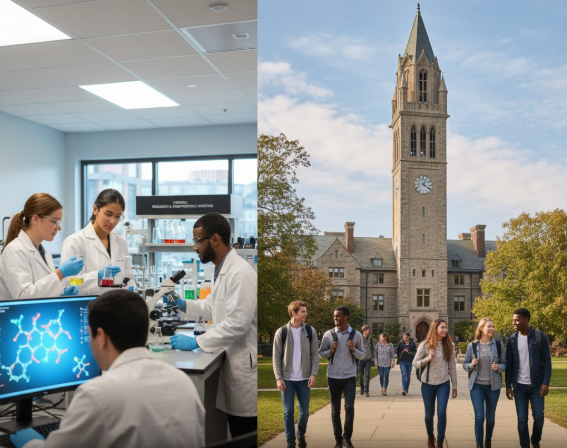
For Cornell, the immediate relief is tangible: laboratories will reopen, research assistants will resume work, and partnerships with government agencies can move forward again. Yet the symbolic weight of the settlement—its reflection of shifting political expectations around diversity and free inquiry—may continue to shape U.S. higher education long after the financial restoration is complete.