
State Challenges President’s Refusal to Assent to Exemption Bill
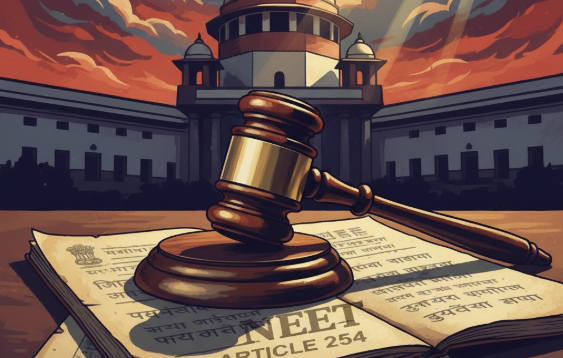
NEW DELHI – The long-standing conflict over the National Eligibility cum Entrance Test (NEET) has intensified, with the Tamil Nadu government formally approaching the Supreme Court of India. The state has filed an original suit under Article 131 of the Constitution, challenging the President’s decision to withhold assent to the Tamil Nadu Admission to Undergraduate Medical Degree Courses Bill, 2021.
The Bill, passed unanimously by the state legislature, sought to exempt Tamil Nadu from the NEET requirement for government-quota medical seats, proposing instead a return to an admission system based on Class XII marks with a scientific normalization process. The President’s refusal, communicated in March 2025, has been termed “patently unconstitutional” by the state, arguing it has led to a “grave constitutional impasse.”
Federalism and the “Mechanical Denial”
The core of Tamil Nadu’s legal challenge rests on the principles of constitutional federalism and legislative autonomy. The state contends that the President’s assent was “mechanically denied” based solely on the advice of the Union Government, and crucially, without assigning any reasons, despite the state having provided detailed replies to all previous objections raised by Union ministries.
The suit raises substantial legal questions regarding the scope of Article 201 (Presidential assent to state bills) and Article 254(2) (which allows a state law on a Concurrent List subject to prevail over a central law if it receives Presidential assent). Tamil Nadu argues that an unexplained withholding of assent effectively “destroys the working” of these constitutional avenues available to states for enacting laws tailored to their specific social realities.
The Social Justice Argument
The state’s opposition to NEET is rooted in concerns over social equity and access. The plea extensively cites the Justice A.K. Rajan Committee report, which analyzed NEET’s impact in Tamil Nadu. The report concluded that the examination system disproportionately benefits affluent, urban students who can afford expensive private coaching, leading to a rise in “repeaters” securing seats.
Conversely, the state argues, the exam has systematically disadvantaged first-generation learners from rural areas, government schools, and Tamil-medium education, undermining the state’s constitutional duty under Article 47 to ensure equitable access to quality public health education. The state asserts that its previous system, based on normalized Class XII marks, was proven to be both equitable and effective in maintaining high medical education standards.
The Supreme Court’s eventual ruling in this matter will not only determine the future of medical admissions in Tamil Nadu but will also set a significant precedent regarding the legislative powers of state assemblies versus the central government’s authority in education, a subject on the Concurrent List.