
Location: Global ; Date: November 20, 2025
The Organisation for Economic Co-operation and Development (OECD) has released a new working paper sounding a significant alarm: the rapid evolution of Artificial Intelligence (AI) capabilities necessitates a fundamental and urgent overhaul of the K-12 school curriculum globally. The paper asserts that current curricula, designed for an era where knowledge acquisition was paramount, are now insufficient to prepare students for a world where AI can generate and synthesize information instantly.
Shifting the Curriculum Imperative
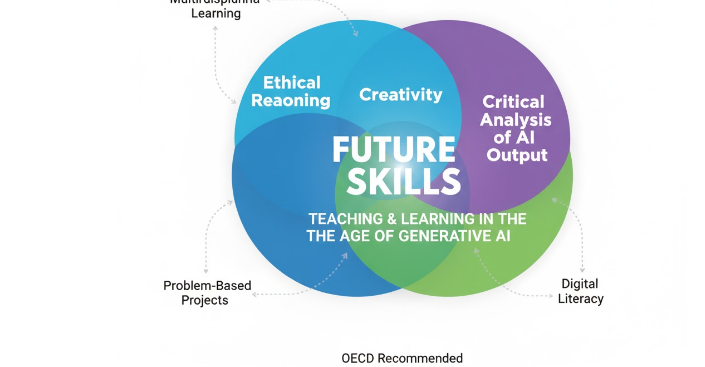
The OECD argues that the focus of Teaching & Learning must shift from “knowing how” to “knowing why.” Key changes demanded by the paper include:
- Beyond Computer Science: The integration of AI literacy must move beyond elective Computer Science courses to be embedded across all major disciplines, including Social Studies and Arts & Humanities. For instance, history classes should focus less on memorizing dates and more on using AI to analyze historical narratives and identify algorithmic bias in data interpretation.
- The “Human” Skills: The paper strongly reinforces the need to prioritize inherently human skills that AI cannot replicate, such as creativity, complex ethical reasoning, emotional intelligence, and interpersonal communication, which are vital for Workforce Readiness and Future Skills.
- Curriculum Decompression: Recognizing that the curriculum is already overcrowded, the paper advocates for “decompression,” recommending that education systems prioritize core, enduring concepts while delegating simple factual recall to AI tools. This requires a difficult but necessary re-evaluation of content standards.
New Disciplines and Assessment
The working paper also addresses the necessity of revising Assessment methods. Traditional testing is increasingly susceptible to AI use; therefore, assessment must pivot to evaluate a student’s ability to use AI ethically and effectively to solve novel problems.
This guidance from a leading global economic body provides concrete backing for education ministers worldwide, particularly in nations like India and those in East Asia which are already aggressively rolling out AI policies, that technology cannot be treated as an add-on, but rather as the catalyst for an educational paradigm shift.