
Global ; Date: November 20, 2025
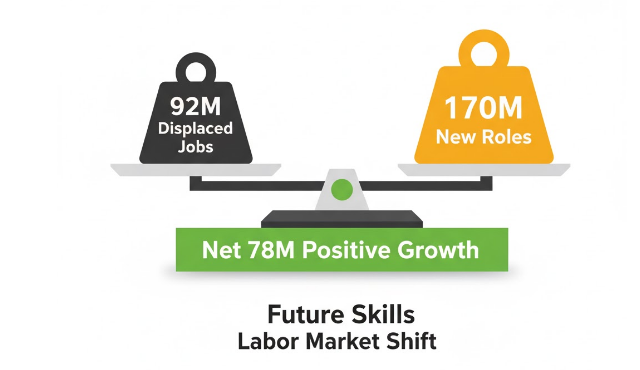
A major report from the World Economic Forum (WEF) has provided critical new data on the future of work, projecting that while technological disruption, primarily driven by Artificial Intelligence (AI) and automation, is set to displace 92 million jobs globally, it will simultaneously create approximately 170 million new roles. This results in a projected net positive creation of 78 million new jobs over the next five years.
The Shift from Displacement to Transformation
The report emphasizes that this massive transformation will not be a simple one-to-one replacement of human roles with machines. Instead, it signals a fundamental restructuring of the global labor market, requiring an urgent and massive push in Future Skills development and Workforce Readiness.
The new jobs emerging are centered around the “Human-AI” interface, requiring skills distinct from the industrial-era model:
- Transdisciplinary Systems Mindset: The WEF stresses that success in the new roles will rely on a transdisciplinary systems mindset. This means combining deep domain expertise (e.g., in finance, medicine, or law) with advanced AI literacy and data analytics. Education systems must move beyond siloed learning to foster skills like holistic problem-solving.
- New Career Pathways: Specific job titles predicted to see rapid growth include Human-AI Collaboration Designers, AI Ethicists, Data Scientists, and Digital Transformation Specialists. These roles require proficiency in both Technology and complex Arts & Humanities skills like ethical reasoning and communication.
- Reskilling Mandate: The report places a high burden on corporate Leadership and Vocational Training programs, noting that approximately 50% of all employees worldwide will need significant reskilling by 2030 to adapt to the new automated reality.
Implications for Global Education
For education policymakers in the US, UK, and East Asia, the report serves as a direct mandate to overhaul Curriculum and Pedagogy. The focus must shift away from skills easily automated (like repetitive data entry or rote memorization) toward complex, uniquely human capabilities:
- Critical Thinking and Creativity: These soft skills are identified as non-negotiable for the future workforce.
- Ethical AI Literacy: Education systems must explicitly teach the societal, economic, and ethical implications of AI use.
The primary challenge is ensuring that this wave of job creation benefits all populations, avoiding the creation of a new Equity & Diversity gap between those who are AI-literate and those who are not.