

Tech & Sustainability Desk | November 3, 2025
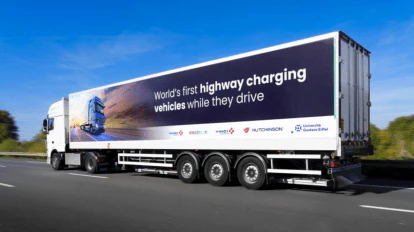
PARIS — In a major breakthrough for green mobility, France has unveiled the world’s first wireless-charging highway, capable of powering electric vehicles (EVs) while they drive. The 1.5-kilometre pilot stretch, inaugurated near Paris, marks a leap forward in the country’s effort to accelerate the transition toward clean, continuous, and range-free transportation.
The new “electric highway” uses inductive charging technology, which transfers energy from coils embedded beneath the road surface directly to receivers installed in compatible EVs. As vehicles move along the track, they draw continuous power — allowing for charging without stopping or plugging in.
Officials from France’s Ministry of Transport hailed the innovation as a “revolutionary step” toward solving one of the biggest challenges in EV adoption — range anxiety.
“This technology will change how we think about electric mobility,” said Transport Minister Patrice Vergriete during the launch ceremony. “The future of highways is not just electric — it’s intelligent and connected.”
How It Works
The road has been developed in partnership with the Italian technology firm Electreon and France’s national highways agency. Copper coils buried under the asphalt transmit electricity wirelessly through magnetic induction. The system is compatible with passenger cars, buses, and trucks equipped with matching receivers, offering charging rates up to 200 kilowatts.
In the Paris pilot, the technology powers a fleet of electric buses and service vehicles. Tests show that even at speeds above 80 km/h, the system delivers consistent energy flow without performance loss.
A Glimpse of the Future
France’s experiment is part of a wider European Union initiative to build sustainable transport corridors. If successful, officials plan to extend the technology to major highways by 2030, with a vision of creating 9,000 kilometres of wireless-charging roads across the country.
The pilot follows similar experiments in Sweden, Italy, and the United States, but France’s project is the first to achieve full-scale public deployment.
Broader Impact
Experts say dynamic wireless charging could significantly cut EV battery sizes and costs, making electric cars more affordable and sustainable. It may also reduce the demand for roadside charging stations and alleviate strain on urban power grids.
Environmental advocates have welcomed the initiative, calling it a milestone in Europe’s effort to meet its net-zero carbon targets by 2050.
“This technology could fundamentally reshape the EV landscape,” said energy analyst Sophie Lemaitre. “It blends clean energy, smart infrastructure, and convenience — the three ingredients the electric revolution needs most.”
Next Steps
Data from the pilot phase will be used to evaluate the system’s scalability, maintenance costs, and environmental impact. If results are positive, the French government plans to partner with other EU nations to standardize wireless-charging infrastructure across borders.
The project positions France at the forefront of global sustainable transport innovation — turning what was once science fiction into a functioning reality on European roads.