
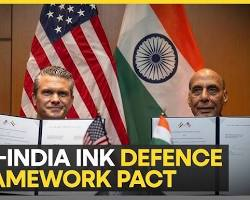
Kuala Lumpur, Malaysia—India and the United States have formalized a new 10-year Defence Framework, elevating their strategic collaboration to a new decade-long roadmap. Signed on the sidelines of the 12th ASEAN Defence Ministers’ Meeting-Plus (ADMM-Plus) in Kuala Lumpur on Friday, the agreement aims to significantly deepen military cooperation, technology sharing, and industrial collaboration, positioning the partnership as a crucial cornerstone for security in the Indo-Pacific.
Defence Minister Rajnath Singh and his counterpart, US Secretary of War Pete Hegseth, inked the “Framework for the US-India Major Defence Partnership,” which supplants and builds upon the 2015 agreement. The pact provides a unified vision and policy direction to enhance cooperation across all domains—land, air, sea, space, and cyberspace.
Key Pillars of the New Framework
The 2025 framework is designed to transform the defence relationship with a focus on:
- Defence-Industrial Collaboration: Prioritizing co-production and co-development of advanced defence systems, supporting India’s development as a logistics, maintenance, repair, and overhaul (MRO) hub, and fast-tracking US export licence approvals.
- Indo-Pacific Security: Strengthening military coordination, information sharing, and interoperability to ensure a “free, open, and rules-bound Indo-Pacific”—a clear strategic counterweight to China’s growing assertiveness.
- Capacity Building: Jointly pursuing capacity building for like-minded partners in Asia, Africa, and the Indian Ocean Region.
Minister Singh hailed the signing as the start of a “new chapter,” stating, “It is a signal of our growing strategic convergence and will herald a new decade of partnership. Defence will remain the major pillar of our bilateral relations.” Secretary Hegseth mirrored this sentiment, describing India as a priority country and confirming that military ties have “never been stronger.”
Expert Opinions on Strategic Significance and Challenges
The new framework is widely viewed as a critical component of Washington’s Indo-Pacific strategy. However, experts offer mixed views on its implementation, particularly regarding technology transfer:
- Strategic Convergence: Defence analysts emphasize the deal’s importance in institutionalizing long-term deterrence. The framework cements military coordination and intelligence sharing, ensuring that India’s forces can better synchronize operations with the US and its allies during crises. As one analyst noted, the partnership is “critical for regional stability and deterrence.”
- The Technology Transfer Hurdle: Despite the rhetoric of “co-production,” some voices express caution. One expert questioned whether the pact represents an equal partnership or merely a “decade-long order book” for American defence contractors. Concerns linger over the actual depth of technology transfer, with a perception that Washington often blocks the transfer of its most advanced “crown jewel” technologies. The successful implementation of the recent agreement to co-produce GE F-414 jet engines in India, which involves an unprecedented 80% technology transfer, is therefore seen as a key test case for the credibility of the entire framework.
- Insulation from Trade Tensions: The signing of the defence pact comes despite ongoing high tariffs and trade friction imposed by the US. Experts say this demonstrates that both nations have successfully insulated their core strategic and defence cooperation from economic disputes, showcasing a pragmatic approach to a partnership driven by shared security concerns in the Indo-Pacific.
The framework underscores a clear alignment in strategic interests, even as the partnership navigates complex economic and regulatory challenges in the coming decade.