
New Delhi | November 7, 2025
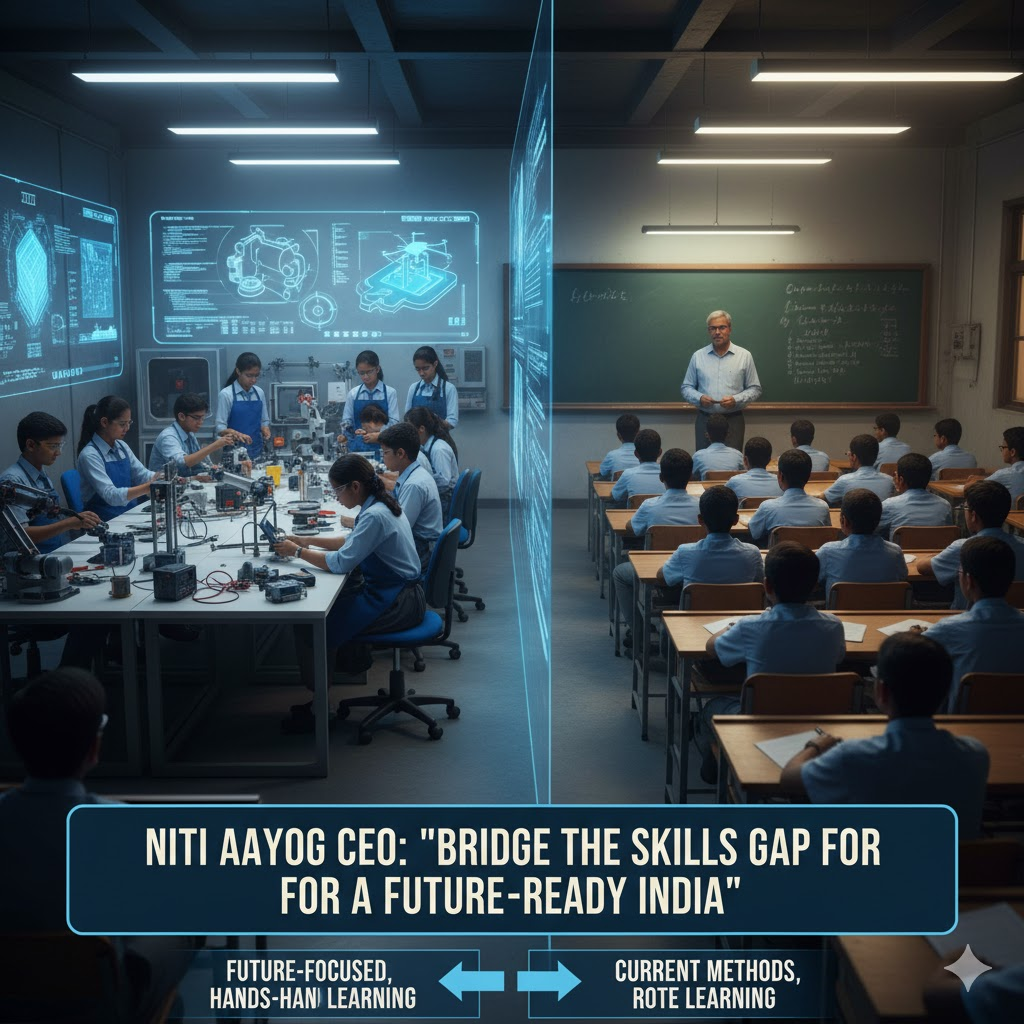
NITI Aayog CEO Flags India’s Education System as ‘Failing Its Youth’
India’s education system is under serious strain, warns B.V.R. Subrahmanyam, Chief Executive Officer of the NITI Aayog, who emphasised that the current ecosystem is not equipping young Indians with the skills required for the modern workplace. The remarks came during his address at the Bengaluru Skill Summit on November 6.
“Our curriculum lacks general employability-skill training, and as a result a majority of our population remains hugely unskilled — doing very low-paying jobs or staying unemployed,” Subrahmanyam said. He cautioned that India’s demographic advantage could turn into a “demographic disaster” if immediate corrective action is not taken.
Key Issues Highlighted
- Subrahmanyam pointed out that vocational and practical training remain largely absent from mainstream schooling and higher education.
- He emphasised that skilling is not just for the young — people in their 20s, 30s, 40s and even 50s need to upskill or reskill to remain employable.
- The CEO called for a comprehensive framework that interlinks formal education, lifelong learning, and employment — moving away from isolated skilling schemes.
- He stated that a strong link between education and the world of work is critical if India is to achieve its ambitious goal of becoming a $30 trillion economy.
Why This Warning Matters
India has been enjoying what is often referred to as a “demographic dividend” — a large working-age population that could power economic growth. But according to the NITI Aayog CEO, that dividend won’t translate into results unless the education system evolves to create employable talent rather than just produce degrees.
With industries increasingly demanding skills like critical thinking, problem-solving, digital literacy and adaptability, education systems that focus largely on rote learning are being left behind. The consequence: many graduates find themselves unable to secure jobs commensurate with their qualifications.
Moving from Access to Quality
While India has made significant strides in expanding access to education, the challenge now is shifting the focus toward quality, relevance and outcomes. Subrahmanyam stressed that embedding skilling into the curriculum — rather than treating it as an optional add-on — is key to transforming the system.
He urged policymakers to design integrated institutions that offer academic, vocational and technical education under one roof, and encouraged the creation of platforms to map skills, link job-seekers with employers and make education systems more dynamic and responsive.
What’s Next
- States and central agencies are expected to accelerate efforts to align schooling and higher education with industry needs and emerging technologies.
- Educational reforms will likely target earlier years as well — ensuring students are exposed to employability, digital fluency and innovation mindset much before the final years of schooling.
- Monitoring mechanisms may be introduced to track not just enrolment, but employability outcomes, and to ensure learning loops between education, skills and employment remain active.