
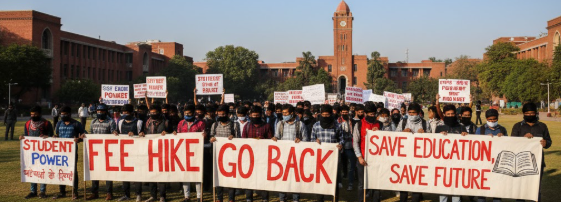
CHANDIGARH – Panjab University (PU) has announced the postponement of all examinations scheduled from November 18 to November 20, 2025, in response to escalating agitation by students demanding the immediate notification of elections for the university’s governing body, the Senate. The decision impacts the main PU campus and over 200 affiliated colleges across Punjab and Chandigarh, causing immediate disruption to the academic calendar.
Core of the Conflict: Governance and Autonomy
The current round of protests, spearheaded by the Panjab University Bachao Morcha, stems from the university’s failure to announce a schedule for the Senate elections, which have been pending for over a year. The agitation has evolved into a broader political movement focused on institutional autonomy after an initial controversial notification from the Ministry of Education proposed restructuring the Senate and Syndicate.
Although the Ministry of Education formally withdrew the notification that sought to trim the size and democratic character of the governance bodies, the student groups have vowed to continue their “university shutdown” until the election schedule is finalized. Protesters had threatened to block and boycott the scheduled semester exams, leaving the administration with no option but to defer the papers to ensure safety and prevent chaos.
Academic Ripple Effect and Student Stress
The postponement immediately affects critical papers for BA and BSc fifth-semester students, including subjects like Physics, Economics, Botany, and Microbiology. The university’s Controller of Examinations, Jagat Bhushan, confirmed the deferment and advised students to monitor official channels for revised dates.
The uncertainty, however, is creating significant stress among the student community:
- Disrupted Schedules: Students who had planned travel, placements, or next semester preparations immediately following the exams now face logistical and academic uncertainty.
- Stress and Anxiety: While some students view the delay as extra preparation time, many expressed concern over the mental exhaustion caused by the continuous changes to the academic timetable.
Political Support and Escalation
The student agitation has gained significant political traction, with major political parties, including the Shiromani Akali Dal (SAD), Aam Aadmi Party (AAP), and the Congress, alongside large farmer groups like the Samyukta Kisan Morcha (SKM), extending their support. This political mobilization has broadened the scope of the protest, framing the Senate election delay as an issue concerning Punjab’s cultural identity and institutional autonomy.
University authorities are set to hold a meeting with protesting unions on November 20, with the outcome of these talks expected to determine the revised examination schedule and the future stability of the campus.