
New Delhi | November 7, 2025
State-Level Education Reforms Gain Momentum Across India
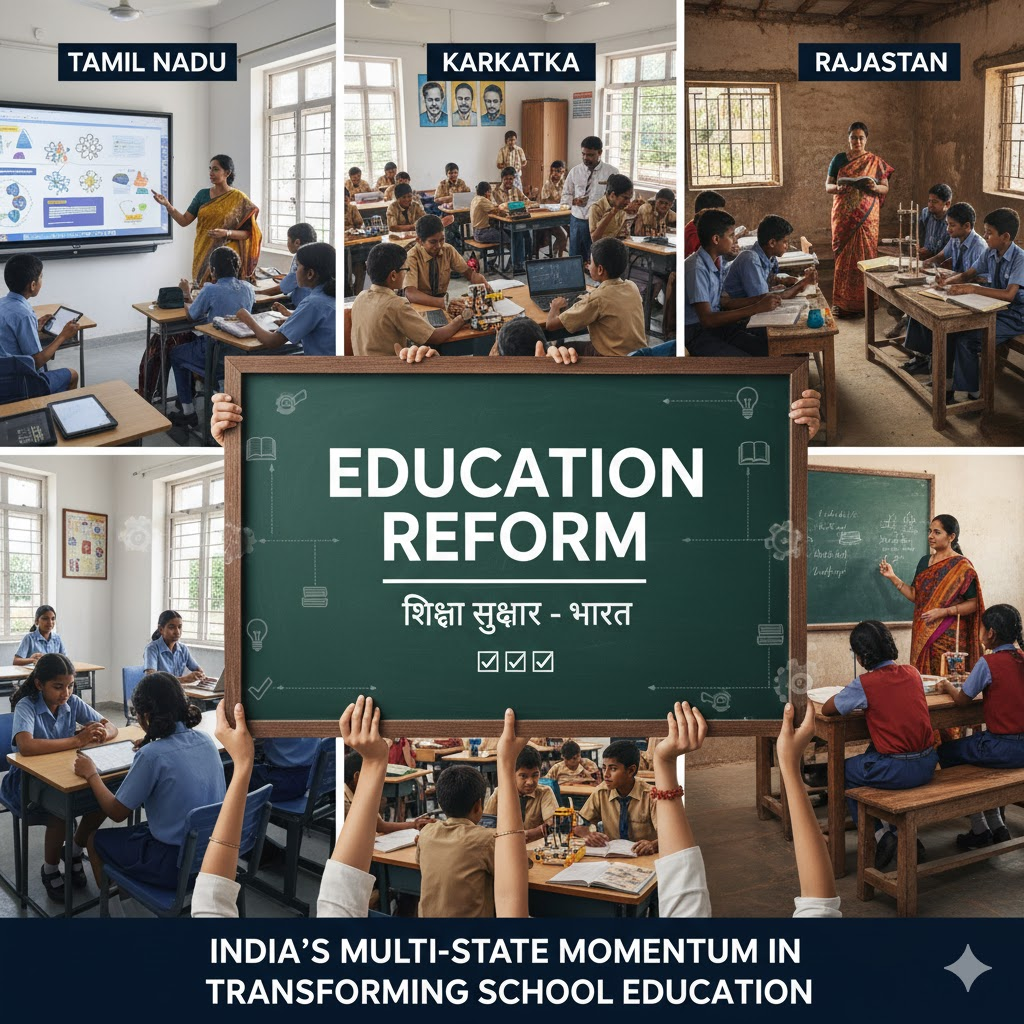
India’s education landscape is witnessing a new wave of state-driven policy reforms, as major states roll out ambitious initiatives to modernise schooling structures, curricula, and community engagement. From curriculum overhauls in Tamil Nadu to mega parent-teacher drives in Karnataka and school mergers in Rajasthan, a pattern of coordinated renewal is emerging across the country’s school systems.
Education analysts say the momentum reflects growing state-level alignment with the National Education Policy (NEP) 2020, while also addressing local needs such as declining enrolment, teacher shortages, and digital inclusion.
Tamil Nadu: Curriculum Redesign Underway
In Tamil Nadu, the government has formed two committees — one expert committee and another curriculum design panel — to revamp the syllabus for Classes I to XII under the state’s recently announced State Education Policy.
The redesigned curriculum, expected to roll out in 2027–28, aims to integrate critical thinking, ethics, environmental awareness, and AI literacy into mainstream education. Officials said the reform will be “contextualised to Tamil Nadu’s culture, economy, and learner diversity” while ensuring alignment with national benchmarks.
Karnataka: Strengthening School-Community Bonds
Meanwhile, the Department of School Education & Literacy, Karnataka, has announced mega parent-teacher meetings across 47,000 government schools on Children’s Day (November 14). The initiative seeks to strengthen community participation, school accountability, and student retention, particularly in rural districts.
Teachers will present learning progress reports, while parents will be invited to discuss support strategies for children’s learning continuity and emotional well-being.
Rajasthan: Consolidating Schools and Resources
Rajasthan is advancing its plan to merge smaller and under-enrolled schools to ensure better resource allocation and improved teaching quality. The move is being implemented alongside PM SHRI school upgrades, including smart classrooms, digital labs, and safety initiatives such as self-defence training for girls in over 625 schools.
State officials argue that consolidation will allow for more equitable deployment of teachers, technology, and infrastructure, ensuring no school operates below viable student strength.
Broader Trend: Localised Innovation, National Impact
Experts note that while each state’s approach differs, the collective direction signals a shift toward decentralised reform — where states innovate within the NEP framework rather than simply adopting central schemes.
“We’re seeing states experiment with models of school consolidation, curriculum redesign, and digital learning that reflect their demographic and cultural realities,” said an education policy researcher with NIEPA.
Several other states, including Maharashtra, Haryana, and Gujarat, are also introducing changes such as digital assessments, AI-integrated classrooms, and teacher training modernisation.
Looking Ahead
As India approaches the halfway mark for NEP 2020’s implementation decade, state governments are emerging as the true engines of transformation. Policy watchers suggest that sustained funding, monitoring, and inter-state knowledge exchange will determine whether these reforms translate into measurable improvements in learning outcomes.