
Date: November 21, 2025
The United Nations Educational, Scientific and Cultural Organization (UNESCO), through its International Task Force on Teachers for Education 2030 (Teacher Task Force), has released a pivotal new Global Position Paper focused on the critical relationship between Teacher Agency and AI in Education. This high-level policy guidance marks a significant step in establishing a global framework to ensure that the rapid integration of Artificial Intelligence enhances, rather than diminishes, the professional role of educators.
Empowering Teachers as AI Designers
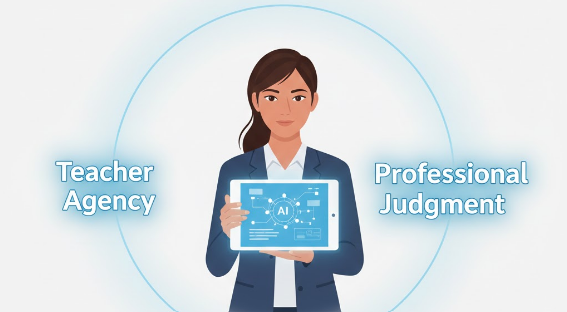
The core mandate of the position paper is to explicitly guide governments and technology developers on “Promoting and Protecting Teacher Agency in the Age of AI.” The paper challenges the current trajectory where AI tools are often developed and implemented without substantive input from the Teaching Profession.
The guidance emphasizes two key policy shifts:
- Teachers as Designers, Not Just Consumers: The paper calls for empowering teachers to be active participants in the design, development, and ethical testing of AI-powered educational technologies. This ensures that tools are pedagogically sound, culturally relevant, and aligned with classroom realities, rather than being imposed as top-down technological mandates.
- Protecting Professional Autonomy: It stresses the necessity of protecting teachers’ intellectual freedom and professional judgment. Agency is defined as the teacher’s ability to make informed decisions about their Pedagogy & Research, curriculum adaptation, and student Assessment, even when utilizing AI tools. AI should serve as an assistant, not a replacement for human expertise.
Global Policy and Ethical Deployment
The paper is designed to inform national Global Education Policy across regions, including the US, UK, India, and East Asia, where AI adoption is accelerating. It directly addresses key concerns around Ethics and Privacy & Security:
- Ethical Deployment: Mandating that AI systems used in education be transparent, explainable, and free from bias that could negatively impact Equity & Diversity among student populations.
- Teacher Preparation: Calling for comprehensive, government-funded Teacher Preparation and professional development programs that focus on AI literacy, enabling educators to critically evaluate AI tools and integrate them effectively into the classroom without compromising academic standards or Student Well-Being.
By prioritizing the teacher’s role, UNESCO seeks to safeguard the quality and human element of education against purely technological solutions, ensuring that AI serves the system rather than dictates it.